

Sun Spot Removal: Why They Stay, and How ThermoClear Lifts Them
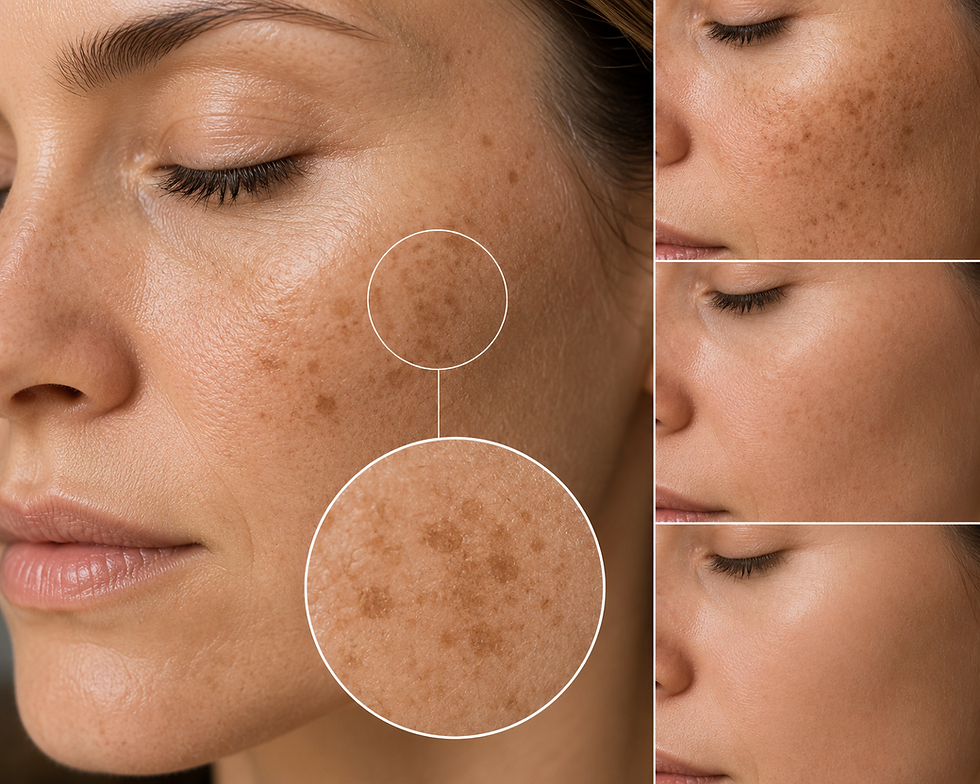
You spent one great summer not reapplying SPF, and now there's a flat brown spot on your cheek that shows up in every selfie. Sun spots are one of the most common things clients bring to us, and one of the most misunderstood. Most people spend a year and a small fortune on brightening products before they realize the spot has barely budged.
Here's what's really going on, and the faster route to clearing it.
What Sun Spots Are
Sun spots, sometimes called age spots or solar lentigines, are flat patches of concentrated pigment. They form when your skin produces extra melanin in response to UV exposure, and that pigment clusters in one area instead of spreading evenly.
They're flat, not raised. They range from light tan to deep brown. They tend to show up where the sun hits most: cheeks, forehead, the bridge of the nose, the backs of your hands, your chest. They're harmless, but they age the face in a way that has nothing to do with your actual skin quality.
How Everyday Sun Catches Up With You
City living is sneaky with sun. You're not lying on a beach, so you assume you're fine. But you're getting incidental UV every single day: the walk to the N train, the outdoor coffee, the window seat at your desk. UVA passes through glass. That daily, unprotected exposure accumulates for years, and sun spots are the receipt.
Why Brightening Serums Take Forever
Ingredients like vitamin C, alpha arbutin, and tranexamic acid can genuinely help fade pigment. The catch is speed and depth. Topicals work gradually and mostly on surface-level discoloration, and they demand months of daily consistency before you see meaningful change. For a defined, set-in sun spot, that's a long road with modest results.
If you want the spot actually gone rather than slightly lighter, you need to treat the pigment directly.
How ThermoClear Removes Sun Spots
ThermoClear delivers radio-frequency energy through a fine probe right to the pigmented spot. The energy lifts the pigment and triggers gentle resurfacing of that exact area. The treated spot darkens, forms a small crust, and then flakes away over the following days, taking the pigment with it.
Because it works only on the surface layer, ThermoClear targets the spot without disturbing the healthy skin around it. It's precise. We treat the mark, not your whole face.
Sessions are fast. Sun spots often take only seconds each. You'll feel a quick warmth on each one.
What to Expect After
The treated spot will look darker and crusty for several days. This is normal and it's the pigment on its way out.
Do not pick. Let the crust flake off naturally, usually within about a week.
SPF is now your best friend. Healing skin plus fresh sun is a recipe for the pigment coming right back. Daily broad-spectrum, no exceptions.
You can go back to normal life immediately. Makeup can cover the area after 24 hours.
One Session or Two?
Many sun spots clear in a single session. Deeper or darker pigment can need a second treatment. We'll assess yours during the consult and give you a straight answer on what it'll take.
Worth naming: ThermoClear treats the pigment you have now. It doesn't stop new spots from forming, so daily SPF is what protects your result long term. We'll build that into your plan.
Book Sun Spot Treatment in Astoria
Ready to stop editing the same spot out of your photos? At Skin Fusion Spa in Astoria, every ThermoClear treatment starts with a consult so we can look at your pigment and map the right approach.


Comments